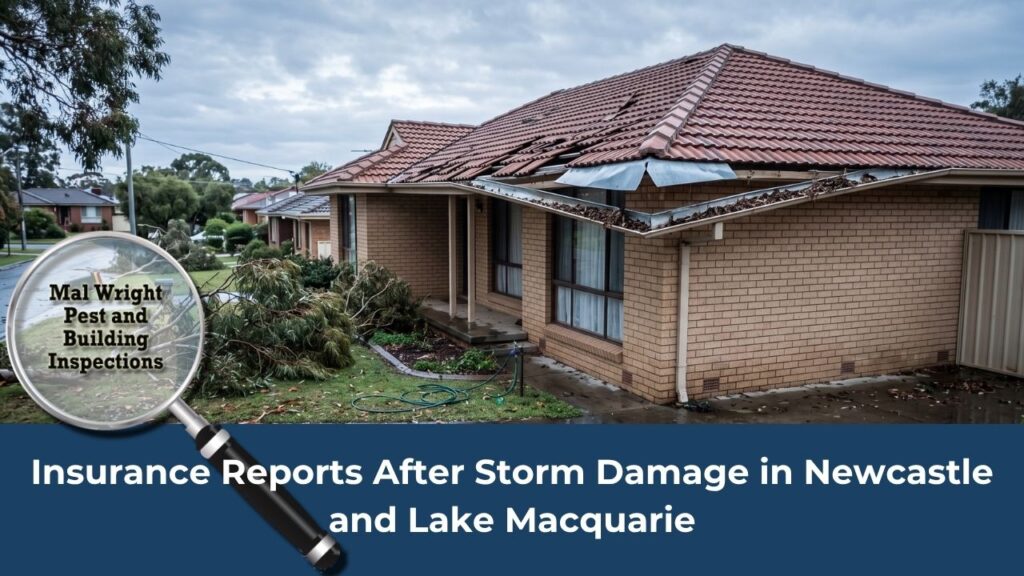
Storm claims in Newcastle and Lake Macquarie rarely get knocked back because the storm didn’t happen. They get knocked back because the insurer says the damage was already there.
Wear and tear. Gradual deterioration. Maintenance nobody got around to. Those exclusions sit in every home and landlord policy, and they are the ground almost every declined storm claim stands on. Once that argument starts, the claim stops being about what the weather did and becomes a contest between two expert reports.
That contest has rules, and most property owners find out what they are far too late. Here’s how the exclusion works, who must prove what, and what separates a report that carries weight from one that gets set aside.
The Argument Behind Almost Every Knock-Back
An insurer declining a storm claim usually points at the roof and says the tiles were already cracked, the flashing was already failing, the gutters hadn’t been cleared.
Some of that will often be true. Most roofs in this region carry wear, particularly the older housing stock through Adamstown, Mayfield and around the western side of the lake.
The point that gets missed is that wear existing is not the same as wear causing the damage. The Australian Financial Complaints Authority has been direct about this. Its general insurance ombudsman has noted that nearly every property has wear and tear to some degree, and the question is whether the wear identified is the proximate cause of the damage being claimed. Where insurers lose these disputes, it is usually because their expert never drew that causal link.
So a report that lists defects is not a defence for the insurer, and a photo of a cracked tile is not a decision. The reasoning between the defect and the damage is what matters.
Who Has to Prove What
This is the part worth understanding before you argue with anyone.
You have to establish that an insured event caused the loss. That is your burden, and it is why documentation immediately after the storm matters so much.
The exclusion is the insurer’s burden. AFCA’s published approach to general insurance claims handling puts it plainly: where the insurer relies on an exclusion such as wear and tear, and that is the only ground raised, insufficient expert evidence means the insurer will likely have to pay the claim.
Read that again, because it changes how you should approach a declined claim. You do not have to disprove wear and tear. You have to show an insured event caused the damage and then hold the insurer to proving its exclusion rather than gesturing at it.
What Makes a Report Carry Weight
AFCA relies heavily on expert reports and rarely commissions its own. It decides on the evidence the two sides put in front of it. That makes the quality of your report the variable you control.
AFCA has published what it looks for. It assesses whether the expert is appropriately qualified, whether the report is logically reasoned, and whether the assumptions line up with the observable facts.
In practice that means a few things. A report that states a conclusion without supporting it is unlikely to be given much weight, particularly against a more detailed and reasoned analysis from the other side. A good report addresses the contrary opinion rather than ignoring it. And it explains a technical finding in terms a layperson can follow, because the person deciding is not a builder.
For a storm claim, that means moisture readings rather than an impression that something felt damp. Thermal imaging showing where water tracked and where it didn’t. An assessment of the stage of timber decay, which distinguishes weeks of moisture from years of it. Photographs tied to specific building elements. A stated reason for each conclusion. We’ve set out what an insurance-grade report contains in more detail separately.
The Clock You Are Working To
Under the General Insurance Code of Practice, once your insurer has all the information it needs and has finished its enquiries, it has 10 business days to accept or decline. Where assessment takes longer, it must update you at least every 20 business days, and it must decide within 4 months, extending to 12 months only in defined circumstances such as an extraordinary catastrophe.
If you complain, ASIC’s Regulatory Guide 271 requires a written response within 30 calendar days for most complaints. An insurer can only go past that by sending you a delay notification explaining why and telling you that you can escalate.
Those timeframes are not always met. ASIC’s December 2024 review of eleven general insurers found one in six complaints were not even identified and recorded as complaints, and that one of the weaker performers met the 30-day response requirement in only 76 per cent of cases. Putting your complaint in writing and referring to the timeframe is not being difficult. It is how you create the record.
If the Insurer Still Says No
Two steps, and both are free.
The first is internal dispute resolution, which is a formal complaint to the insurer’s own complaints team rather than another conversation with the assessor. If your claim was declined or reduced, you are entitled to written reasons.
The second is AFCA. It is free for consumers, and its determinations bind the insurer if you accept them. Because AFCA decides on the material provided, an unanswered insurer report tends to win by default. That is the single most common reason a reasonable complaint fails.
Free help exists for this. The Financial Rights Legal Centre runs the Insurance Law Service and can talk you through a complaint at no cost.
Storms Here, Specifically
The lake and the coastal strip cop the worst of the wind and hail, while properties inland around Morisset and Cooranbong deal more with saturated ground and water that has nowhere to go. We have written separately about what storm damage looks like across Lake Macquarie and where it hides, so we won’t cover that ground again here.
The relevant point for a claim is timing. Damage documented within days of a storm is far easier to attribute to that storm than damage documented three months later, after a second weather event and a summer of drying out.
Book a Storm Damage Report
If a claim has been declined or cut back, or you want the evidence recorded properly before it is, we inspect across Newcastle, Lake Macquarie, Port Stephens, Maitland and the Hunter Valley.
Call Mal Wright on 0488 885 203 or order an inspection online. We report what we find, whichever way it points.
This article is general information about how the claims process works. It is not legal or financial advice, and it is not a substitute for advice about your policy or your circumstances.