Lake Macquarie gets hit. It’s a fact of living here.
The storms that roll through from the coast, particularly between October and March, bring heavy rain, strong winds, and hail. Properties around the lake’s eastern shoreline cop the worst of the coastal exposure. Those further inland around Morisset, Cooranbong, and Wyee deal with a different problem: extended periods of rainfall, saturated ground, and water that has nowhere to go fast.
After a significant weather event, a lot of property owners do a quick walk around, check the gutters, look at the ceiling for stains, and assume everything is fine if nothing obvious has appeared. That assumption costs people money.
What Storm Damage Actually Looks Like
The visible stuff is easy. A cracked tile. A fallen fence panel. A branch through the pergola roof.
What’s harder to spot is the damage that doesn’t show itself immediately, or that shows up in the wrong place, well away from where the water entered.
Roof damage is the most common cause of post-storm building problems, and it’s one of the most consistently underestimated. A displaced ridge cap, cracked tile, or failed flashing lets water into the roof space. That water doesn’t necessarily track straight down to the ceiling below it. It follows the path of least resistance: along rafters, across sarking, into wall cavities, and can end up causing ceiling staining, timber decay, or mould growth metres away from the actual entry point.
Moisture is also invisible until it isn’t. A wet roof space with inadequate ventilation after a storm can take weeks to dry out fully. In that time, timber framing absorbs moisture, creating conditions that accelerate decay and attract termites. There’s no ceiling stain. No visible damage from inside the house. The problem is sitting up in the roof space doing its work quietly.
Why Thermal Imaging Changes What Gets Found
A visual inspection after storm damage is better than nothing, but it has real limits.
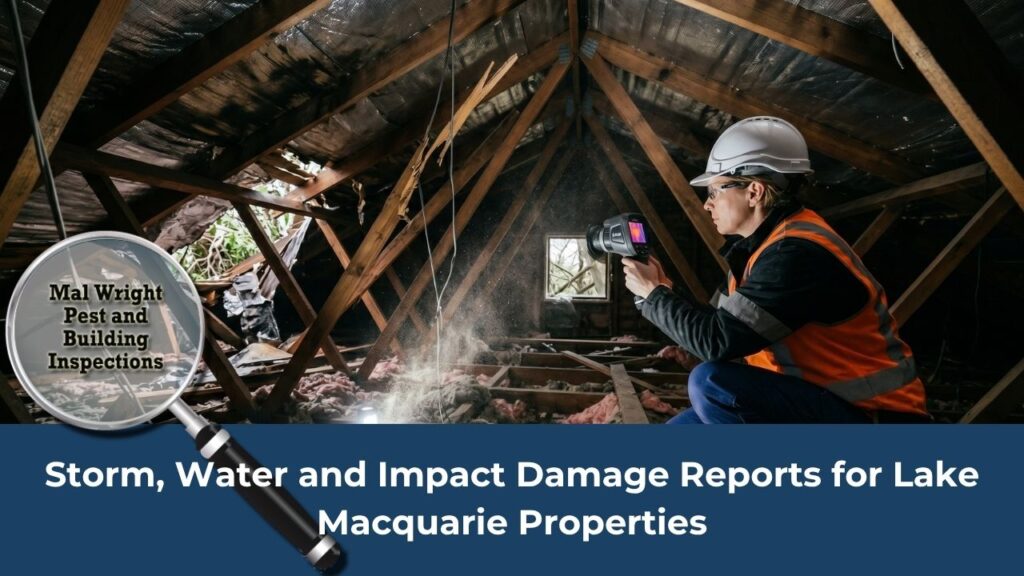
Thermal imaging detects moisture and heat patterns that aren’t visible to the naked eye. Water that has tracked into a wall cavity after rain shows up as a clear moisture signature on the camera, even when the painted surface looks completely dry. We’ve found significant water ingress in external walls where the internal plaster showed no discolouration at all. The leak had been running for weeks.
The thermal camera we use detects things that other cameras simply don’t pick up. Some inspection companies use entry-level thermal cameras. The difference in what they find is significant, particularly with water damage where temperature differentials are subtle.
On every inspection I also carry a Tramex moisture meter. Shower areas, wet rooms, and any wall that’s had water near it gets checked. High moisture readings in places that should be dry tell the story long before visible damage develops.
What a Storm Damage Report Covers
A building inspection for storm or water damage isn’t just about the roof. It’s a full assessment of how the event affected the property and what the consequential risks are.
That means getting into the roof space. Not looking through the manhole from a ladder. Getting in there and moving through the space to check rafters, purlins, sarking, insulation condition, and any evidence of water entry. It means checking under the floor if there’s a subfloor area, particularly in older Lake Macquarie homes where subfloor timbers can be affected by flooding or prolonged saturation.
The report documents every defect found: photographed, clearly described, and separated into what needs immediate attention versus what can be monitored or addressed over time. It’s written in plain English, not building jargon, so you can understand what you’re looking at.
Insurance Claims and the Paper Trail
If you’re making an insurance claim for storm damage, a professional building inspection report from a licensed builder and building consultant strengthens your position significantly.
Insurance assessors work for the insurer. Their job is to assess the claim. Having an independent report from your own inspector, someone working for you rather than the insurer, that documents damage thoroughly with photographs and clearly attributes it to the weather event gives you a record you control.
This matters more than people think. Damage that isn’t documented properly at the time of inspection can be difficult to claim later, particularly if the insurer argues that deterioration occurred over time rather than from the specific event. A thorough post-storm inspection report, completed promptly after the weather event, establishes the condition of the property at that point in time.
That paper trail also matters if you’re a landlord with tenants, or if you’re preparing to sell and want to demonstrate the property’s condition clearly.
Lake Macquarie Specifically
Properties around the lake have some specific vulnerabilities worth knowing about.
Older homes in suburbs like Belmont, Swansea, Morisset, and Toronto, many built in the 1950s through 1970s, often have galvanised iron roofing, original timber framing, and subfloor construction that’s more vulnerable to prolonged moisture exposure than modern builds. These properties can look perfectly solid from the street while carrying real storm damage risk in places that only get seen during a proper inspection.
Waterfront and near-waterfront properties deal with additional salt air exposure that accelerates corrosion of metal fixings, flashing, and guttering. A storm that would cause minor damage to an inland property can cause more significant problems on a lakefront home where the existing weathering has already been doing its work for years.
When to Book
Ideally, within a few weeks of a significant storm event, while conditions are still consistent with what the weather caused and before any natural drying makes moisture evidence harder to detect.
If you’ve noticed ceiling staining, cracking around windows or door frames, or any change in how your home feels after a weather event, don’t wait for it to develop further.
Call 0488 885 203 or Order an Inspection online today. We service Lake Macquarie and surrounding areas including Belmont, Swansea, Toronto, Morisset, Cooranbong, and all suburbs in between.