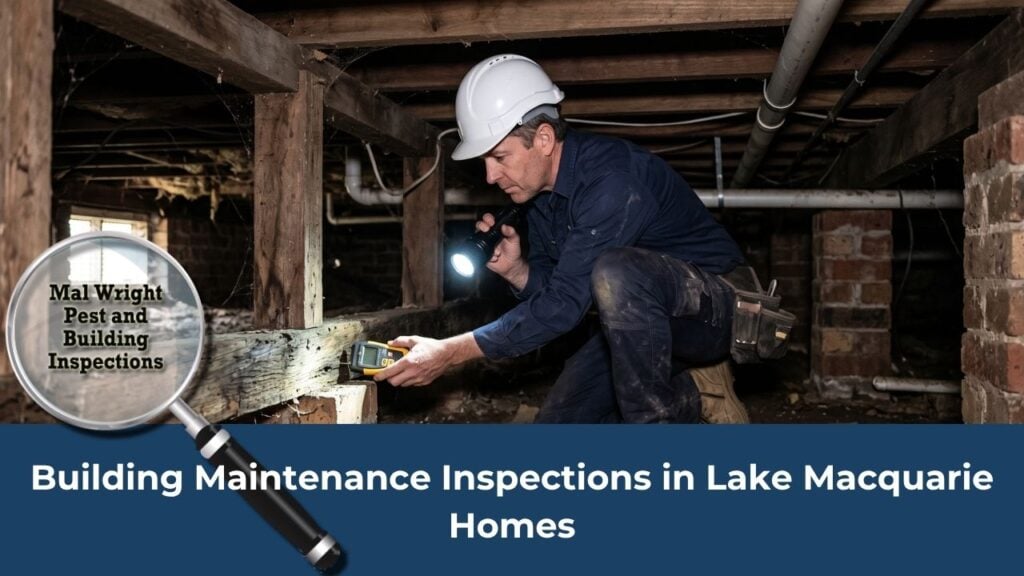
A building maintenance inspection is an independent check on the condition of a home you already own. It’s not about a sale and it’s not about a claim. It’s about finding the things that are quietly getting worse, working out which ones matter, and giving you enough warning to fix them on your own timetable instead of in an emergency.
Around Lake Macquarie that matters more than it does in most parts of the state, and the reason is sitting right there in the middle of the map.
What a building maintenance inspection covers
An inspector walks the property and gets into the parts of it you don’t. Roof space, subfloor, external walls, wet areas, drainage and site conditions, all the accessible areas. Timber pest activity gets checked at the same time if you book both.
What comes back isn’t a pass or a fail. It’s a written record of condition with the issues sorted by urgency, so you can see what needs doing now, what can wait a year, and what’s just worth keeping an eye on. Moisture readings and thermal imaging pick up water movement behind linings well before a stain appears on the ceiling.
What we keep finding in Lake Macquarie homes
After more than 25,000 inspections across the region, patterns emerge. These are the ones tied to this particular postcode.
Salt comes off the lake, not just the ocean
Lake Macquarie is a saltwater lake, open to the sea through the channel at Swansea, and it covers around 110 square kilometres with roughly 174km of shoreline. Plenty of owners in Warners Bay, Speers Point, Toronto, Coal Point and Wangi Wangi assume salt corrosion is a Blacksmiths and Caves Beach problem. It isn’t. Onshore breezes carry salt aerosol well back from the water.
Where it shows up first: roof screws and tek fixings, valley and parapet flashings, garage door tracks, balustrade fixings, window hardware, and steel lintels above openings. A rusting lintel lifts the brickwork above it and cracks the wall. Caught at the surface-rust stage it’s a cheap job. Caught after the brickwork has moved, it isn’t.
Subfloors in the low-lying suburbs
Marks Point, Pelican, Swansea, Belmont South and the flat pockets around Bonnells Bay sit close to the water table. Add a wet spring and a subfloor that was never ventilated properly, and you get sustained high moisture under the house.
Bearers and joists don’t fail suddenly; they soften over years. So do stumps and ant caps. The tell is usually a springy floor near an external wall, and by then there’s often decay in the timbers either side of it. High subfloor moisture also brings termites in close, which is why a timber pest inspection belongs on the same visit.
Mine subsidence country
Boolaroo, Speers Point, Teralba, Cardiff, Edgeworth, West Wallsend, Holmesville, Barnsley and Seahampton all sit in declared Mine Subsidence Districts. If cracking traces back to old underground coal workings, it’s not a home insurance matter. Compensation claims go to Subsidence Advisory NSW. Reading a crack correctly, its direction, width, taper and signs of ongoing movement, tells you which of those two paths you’re on. Guessing wrong costs months.
Fibro from the 1950s and 60s
Windale, Gateshead, parts of Swansea and older streets around Morisset carry a lot of asbestos cement sheeting from the post-war build. It’s stable while it’s sound and painted. It becomes a problem when it’s cracked, drummy, weathered back to bare, or getting drilled into by someone hanging a pergola. A maintenance report flags suspect material and its condition, then points you to a licensed assessor. Building inspectors don’t sample or clear asbestos, and anyone who tells you otherwise is out of their lane. SafeWork NSW sets out what’s required.
Reactive clay under the new estates
Cooranbong and Morisset have grown fast, and a good share of that new stock sits on reactive clay. Those soils swell and shrink with moisture, which is normal and designed for, but only if the site drainage still works the way it did at handover. Downpipes discharging next to the slab edge, garden beds built up over the slab and blocked ag lines all concentrate water where it does the most harm. Stair-step cracking in the brickwork and doors that stick in one season and not the other are the early signs.
Gutters on the bushland edge
Martinsville, Awaba, Freemans Waterhole, Wyee and the western fringe get heavy leaf loading. Full gutters back water up under the roof sheets and into the eaves, and the rot works inward from the fascia. Storm season here runs roughly October through March, so gutters want clearing before it starts, not after the first big one.
How often should you have it done?
There’s no single answer, and any inspector who gives you one hasn’t looked at your house. Exposure and construction type drive the interval.
| Property type | Inspect every | Why |
| Waterfront or lakeside home | 12 months | Salt exposure moves fast on fixings and flashings |
| Older fibro or weatherboard home | 12 to 18 months | Sheeting, stumps and subfloor timbers need watching |
| Brick and tile on a slab, inland | 2 years | Slower to deteriorate, but movement still shows up |
| Rental property | 12 months | Duty of care, plus a documented condition history |
| Home backing onto bushland | 12 months | Gutter loading and constant termite pressure |
If the place has never been inspected since you bought it, the first one is the useful one regardless of type. After that you’re just tracking change.
Using the report to control what you spend
This is the part most owners underuse. A maintenance report is a scope document, and it’s worth real money at quoting time.
- Send the same report to three trades and they quote on identical scope, so you can compare the numbers
- It’s much harder for anyone to add work that isn’t in the report
- You can stage the spend across financial years using the urgency ratings
- If a quote comes back at twice what you expected, you’ve got an independent document to check it against
We don’t do repairs. We’re paid for the inspection and nothing else, so there’s no version of the report where it suits us to find more work. If you want a second opinion on a quote after the fact, that’s a conversation worth having, and it’s the same reasoning behind an independent building defect inspection when you’re in dispute with a builder.
The insurance angle owners miss
Most home policies exclude damage caused by gradual deterioration, lack of maintenance, or defects the owner knew about and left alone. That exclusion gets applied more often than people expect, and it’s usually applied after the damage is done.
A run of dated inspection reports does two things. It shows you’ve taken reasonable care of the building, which is exactly the question an insurer asks when they’re deciding if a claim is wear and tear. And it establishes what condition the property was in before the event, which removes most of the argument about what the storm caused.
For landlords there’s a second layer. Documented inspections go to the duty of care you owe tenants, and they’re the difference between a defensible position and your word against theirs.
Why experience shows up on this kind of job
Pre-purchase inspections are about finding what’s wrong. Maintenance inspections are about judging how fast it’s getting worse, and that’s a harder call. Surface rust on a lintel and a lintel that’s three years from moving the brickwork look similar in a photo. Knowing the difference comes from having seen both play out.
Mal Wright holds an unrestricted NSW builder licence (No. 40501), completed his carpentry and joinery apprenticeship in 1982, and is a Certified Building Clerk of Works and Accredited Timber Pest Inspector. Mal Wright Pest & Building Inspections is an accredited member of the Australian Society of Building Consultants, one of only a few in the Newcastle and Hunter regions. Inspections are carried out to AS 4349.1 and AS 4349.3.
The team have been running thermal imaging for over 12 years, using a Bullard T4 camera and Tramex moisture meters. That combination finds water behind a wall before it finds you.
Booking an inspection
We inspect right across Lake Macquarie, from Cardiff and Charlestown down through Warners Bay, Toronto and Belmont to Swansea, Morisset and Wyee. Reports are usually back to you the same day as the inspection.
See what’s covered on our building maintenance inspection page, call the office on 0488 885 203, or order an inspection online.